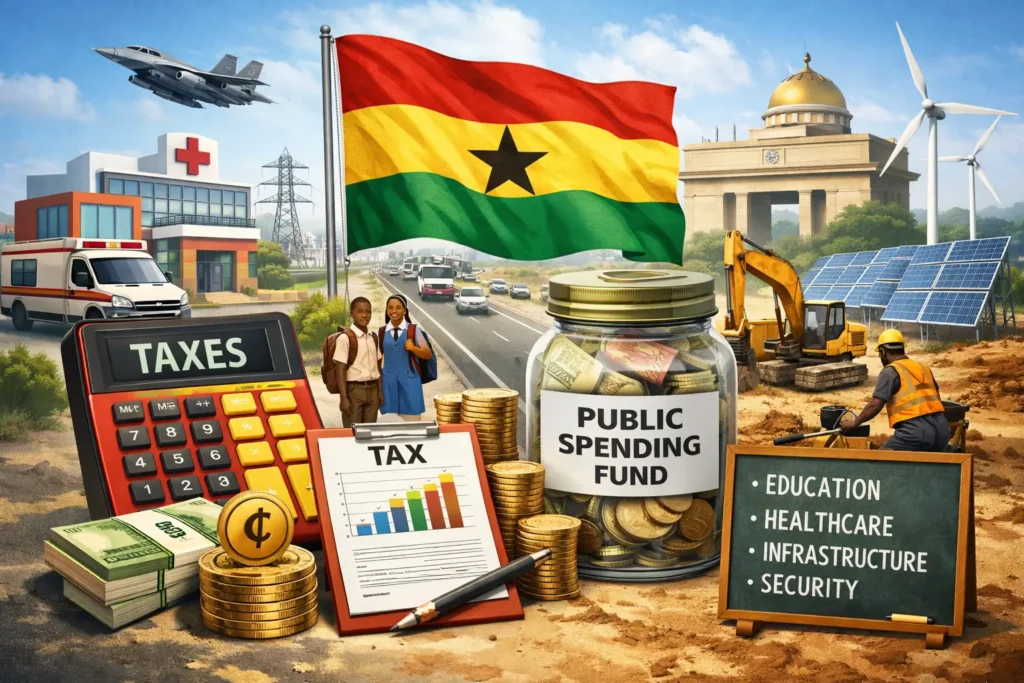
Taxes and Public Spending are the lifeblood of a democracy. It is the duty, obligation and responsibility of elected representatives in Parliament to formulate, oversee, and monitor public spending. Taxes need to be the revenue source that supports annual Public Spending, not long-term debt from World Bank Loans.
The Executive Branch of Ghana rifled with corruption over the last few decades has found it all too easy to mortgage the future of Ghana. Loans from the World Bank and selling natural resources to foreign nations and corporations have soared the National Debt.
The continuous escalation of the national debt by past administrations is a direct result of lack of planning, corruption and incompetence. Each of the last five Executive Administrations in Ghana have gone hat in hand to the World Bank for loans. The collateral they have pledged are the resources, hope, future dreams, sweat and labor of the Ghanaian people now and decades into the future.
Taxes
To begin to clear the fiscal catastrophe caused by the NDC and NPP when elected I will:
- Perform a detailed forensic audit of all executive branches and Parliament expenditures throughout the past five administration. The auditors and investigators will be given subpoena and confiscatory powers approved by the Judiciary on a case-by-case basis.
- Cut all Executive Branch salaries and Departments by 10- 25% for the current budget.
- Cut the number of Ministries to ten.
- End ex-gratia and Article 71 payments immediately.
- Seek out and demand resignation of double dippers, those who hold multiple government and appointed industrial positions.
- Put in place strict auditing procedures for all tax collections, and government fees.
- Work to end income tax for those who earn less than an established minimum.
- Pass a progressive income tax with three tax brackets, 10%, 20%, and 30%.
- Form a commission to examine and suggest fair tariff and import fees not to exceed 15% for foreign importers and 7.5% for Ghanaian owned importers.
- Pass a law to allow those Ghanaians living in the diaspora to bring earned assets back to Ghana with a minimum 5% tax once every 5 years.
- Pass a tax code that allows 100% Ghanaian owned enterprises, businesses, and initiatives to have the ability to write off all receipted investments up to 50% of earned income.
Public Spending
All public spending must maintain and stay within the constraints of the stated budgets. It is incumbent on all MPs to pass budgets that hold accountability and value as the highest standard. Public spending must accomplish achievable goals.
Every government contract and department must answer to the Minister of Finance, the Minister of Justice and the Office of the Vice President within 5 business days when called upon to produce receipts or justify expenses.
I look forward to establishing a National Budget that meets International Accounting standards. Each Annual Budget will be required to break down expenses and revenues on a balanced line-item basis. My intention with input of the Finance Minister is to put in place by law a dual accounting system for checks and balances. Every Annual Budget will audit at the 6- and 12-month mark.
Public Spending serves the sole purpose of providing Public Value. All contracts must be transparently auditable on a two-day notice by any Presidential, Ministerial or Court Order. Public hearings must be regularly scheduled and accessible to citizens to discuss performance of government services.
Each Annual Budget Must include three mandatory long-term development line items to meet the development plan that I am proposing as part of the Constitution.